

Executive Officer to School Administration
Employment Communications, Staffing Decisions, Administrative Correspondence, and Documentary Records
This page presents documents, communications, employment records, and supporting evidence relating to the Executive Officer function at International Christian School Nonthaburi (ICSN). The record includes recruitment communications, employment discussions, staffing decisions, administrative correspondence, and related documentation for independent review.

Nathaniel (Nate) Gurnett
Executive Officer to School Administration
This section presents communications, employment correspondence, staffing records, and administrative documents associated with Nathaniel Gurnett in his role as Executive Officer to School Administration at International Christian School Nonthaburi (ICSN). The materials provide context regarding recruitment activities, employment communications, staffing decisions, and administrative actions documented during the period under review.
The documentary record includes recruitment communications, employment discussions, medical leave communications, staffing coordination, and correspondence relating to employment decisions. Several documents reflect interactions between the Executive Officer function, school leadership, and employees during significant administrative and employment-related events.
Readers are encouraged to review the original documents and supporting evidence and assess the communications, decisions, and explanations provided within the record. The purpose of this archive is to preserve relevant documentary materials and provide context for independent review and evaluation.
Employment Communications
This section examines employment decisions, administrative communications, and termination documents associated with the Executive Officer's involvement in the events leading to the employee's removal from classroom duties and subsequent termination.
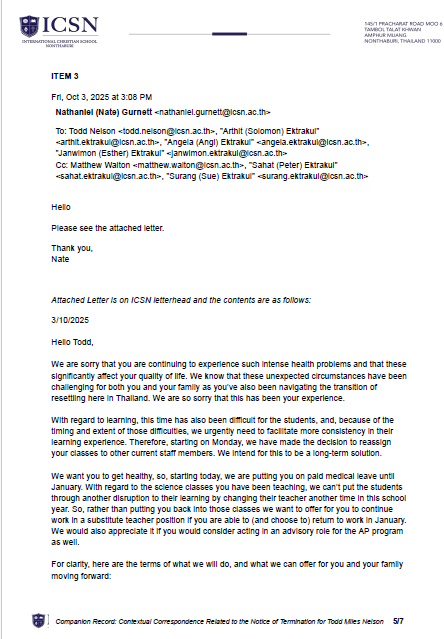
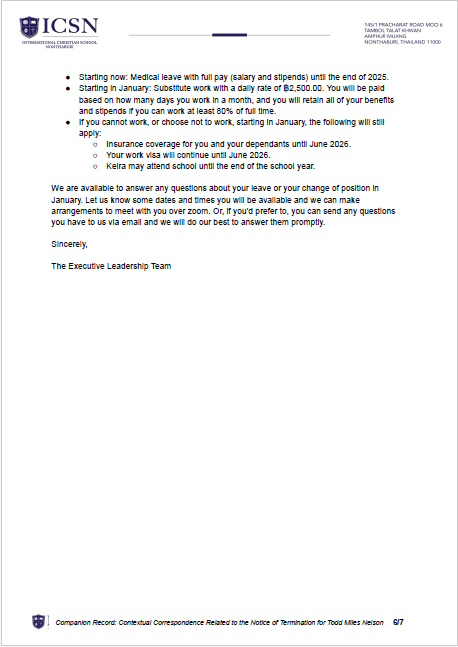
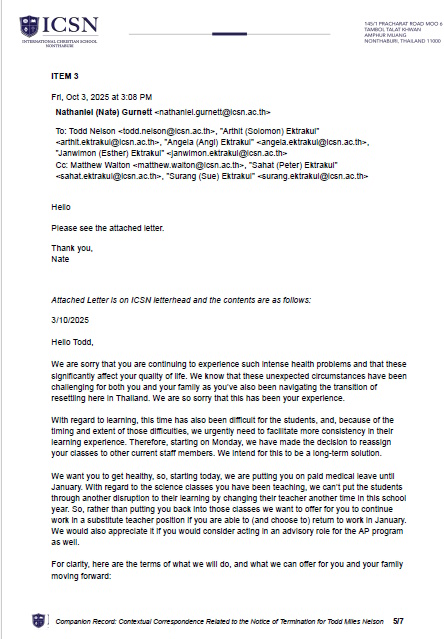
The documents include correspondence regarding medical leave, reassignment of teaching responsibilities, requests for consultation, termination communications, proposed settlement terms, continued insurance arrangements, and allegations cited as justification for dismissal. Together, these records provide a chronological account of the decision-making process and the actions taken during a period when the employee was hospitalized following a serious medical emergency.
The majority of the documents presented on this page were preserved and provided by a former employee directly involved in the events described. Additional records were provided by current and former employees, parents, and other individuals with direct knowledge of the matters discussed. Together, these materials provide a broader documentary record of administrative practices, employment procedures, safeguarding concerns, insurance matters, and decision-making processes. Readers are encouraged to review the original documents and supporting evidence to evaluate the consistency between the contemporaneous record and subsequent actions affecting employment, medical coverage, and student enrollment.

Exclusion from the Decision-Making Process
Refusal to Meet, Consultation Denied, and Decisions Made Without Employee Participation
- Major employment decisions were made while the employee remained hospitalized.
- Multiple requests for meetings, telephone calls, and consultation were made.
- No documented face-to-face meeting occurred.
- Decisions regarding employment and classroom replacement proceeded before meaningful consultation.
- The termination later stated that consultation would not have changed the outcome.
- The record raises questions regarding procedural fairness and employee participation in decision-making.

Community Safety Allegations
Hospitalization, Legal Threats, and the Subsequent Narrative
- The safety narrative appears to originate from a single October 3 telephone call while the employee was hospitalized and physically incapacitated following a catastrophic spinal cord injury.
- No threat assessment appears in the documentary record.
- No witness statements appear in the documentary record.
- No formal investigation records appear in the documentary record.
- No documented safeguarding measures were implemented to protect students or staff.
- No police report, police notification, or emergency intervention appears to have been initiated.
- School leadership continued normal communications with the employee following the call, including employment discussions, support communications, and ongoing contact.
- Approximately five days passed between the call and the eventual termination decision.
- The termination documents simultaneously describe the employee as a safety risk while also stating that leadership remained open to discussing future employment arrangements.
- The record raises questions regarding how a conclusion of community risk was reached, documented, and reconciled with the actions taken by leadership immediately afterward.
If someone is truly a danger to children and staff, schools do not spend five days discussing employment options, exchanging messages, sending support, and debating staffing arrangements. They immediately implement safeguarding and risk-management procedures.

Health Insurance and Benefit Leverage
Medical Coverage, Release Conditions, and Loss of Future Access to Care
- The employee suffered a severe neurological and spinal cord injury requiring ongoing medical treatment and long-term specialist care.
- Health insurance became a critical issue because future treatment costs remained uncertain and the employee became effectively uninsurable for injury-related conditions.
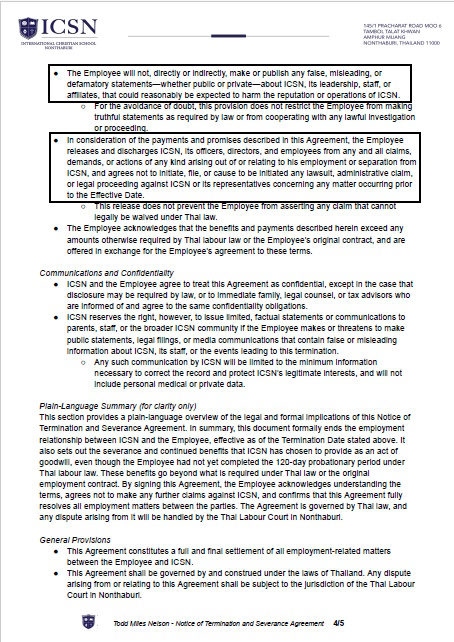
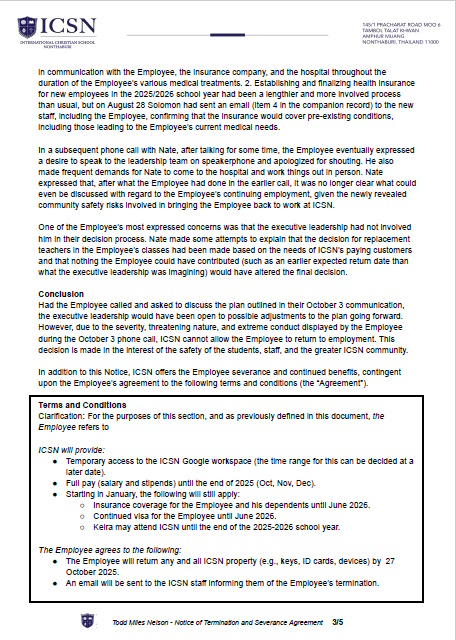
- Continued health insurance coverage, visa sponsorship, and the employee's daughter's continued school enrollment were made contingent upon acceptance of a separation agreement.
- The proposed agreement required execution of broad release of claims, hold harmless provisions, confidentiality obligations, and restrictions on future actions against the school and its representatives.
- Refusal to sign resulted in withdrawal of continued insurance coverage and the loss of continued enrollment for the employee's daughter.
- The record raises questions regarding whether essential medical coverage and educational access were used as leverage during a period of extraordinary medical vulnerability.
- The timing is significant. These conditions were presented while recovery from a catastrophic spinal cord injury remained ongoing and future medical outcomes were not yet known.
- The documents invite consideration of whether the protections offered were intended to support recovery and family stability or were conditioned upon acceptance of legal and contractual concessions.

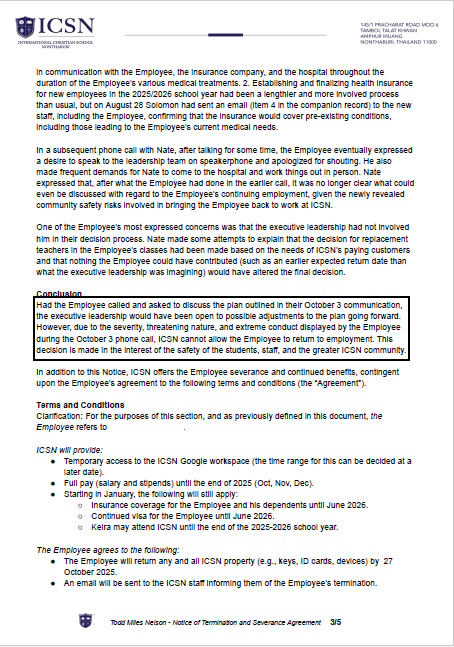
Termination and Release Agreement
Waiver of Claims, Confidentiality Requirements, and Employment Separation
- The agreement was presented while the employee remained hospitalized following catastrophic spinal cord surgery and severe neurological injury.
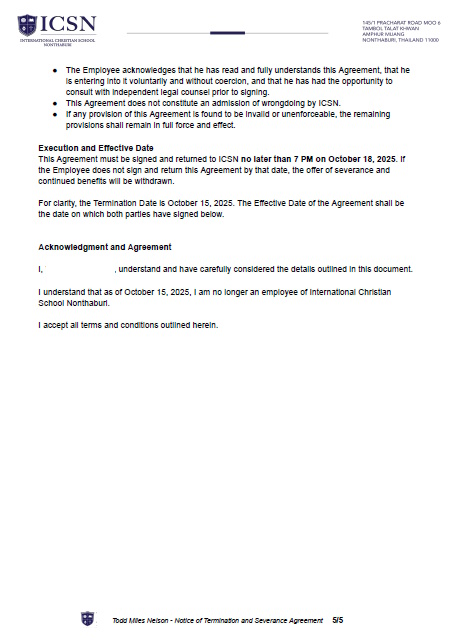
- The employee was given approximately three days to decide whether to accept the agreement.
- At the time, the employee was physically incapacitated, dependent upon others for daily care, and facing an uncertain medical future.
- Continued health insurance, visa sponsorship, and the employee's daughter's continued enrollment were conditioned upon acceptance of the agreement.
- The agreement required broad releases of claims, hold harmless provisions, confidentiality obligations, and restrictions on future actions against the school and its representatives.
- Refusal to sign resulted in withdrawal of continued insurance coverage and loss of the employee's daughter's continued enrollment.
- The timing is significant. The agreement was presented during a period when the employee's immediate focus was recovery from life-changing injuries rather than legal negotiation.
- The record raises questions regarding whether meaningful consent could be obtained from a hospitalized employee facing the loss of medical coverage, immigration status, and educational continuity for his child.
- Readers may wish to consider whether the agreement functioned as a voluntary settlement or whether essential benefits were conditioned upon acceptance of legal concessions during a period of extraordinary vulnerability.
Image Gallery
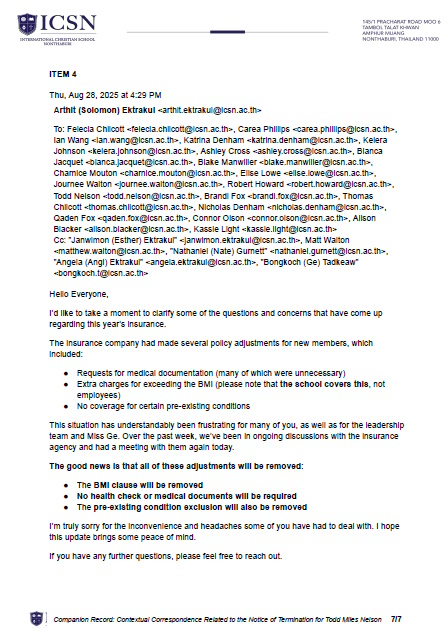
This section contains correspondence and employment records relating to proposed reassignment, medical leave, community safety allegations, termination decisions, and separation agreements. The documents raise questions regarding consultation, procedural fairness, continued access to health insurance, and the consistency of explanations provided during a period of serious medical recovery. Most documents were preserved by a former employee directly involved in the events described and are presented in chronological order for review.
Independent AI Analysis of Executive Administration Records
Consultation, Employment Decisions, and Preferential Treatment
- Major employment decisions were made while the employee was hospitalized with a catastrophic spinal cord injury.
- The employee was afforded approximately 17 days before termination while medically incapacitated.
- School records indicate principal's spouse received approximately two months of leave without comparable employment consequences.
- Repeated requests for discussion regarding medical recovery and return-to-work options were not accommodated.
- Decisions affecting employment, compensation, and future benefits proceeded while the employee remained hospitalized.
- The documentary record raises significant concerns regarding unequal treatment, preferential accommodation, and the consistent application of employment practices.
Community Safety Allegations, Consultation, and Contradictory Explanations
- The October 3 telephone call ultimately became the primary basis for termination and later safety allegations.
- Five days elapsed between the call and the termination decision, despite no documented indication that school leadership viewed the matter as an immediate safety threat at the time.
- In cases involving genuine threats to student or staff safety, immediate safeguarding measures would ordinarily be expected, including incident reporting, threat assessment, security measures, welfare notifications, or law enforcement contact.
- No police report, threat assessment, safeguarding response, security measures, emergency procedures, or child protection actions appear in the records reviewed.
- At the time, the employee was hospitalized with a catastrophic spinal cord injury, suffering severe neurological impairment, and required assistance with basic daily activities, including feeding himself. The record raises questions regarding the plausibility of allegations involving physical danger during this period.
- During the same period, school leadership continued supportive communications, employment discussions, and other routine contact with the employee. The Executive Administrator sent food to the employee's residence and the Executive Officer participated in multiple telephone discussions after the alleged incident.
- Witnesses supporting the allegations appear limited to individuals connected to school leadership or the license holder, while independent witnesses identified by the employee do not appear to have been formally considered.
Requests for Discussion, Decisions Made in Advance, and Procedural Fairness
- On October 2, the employee was placed on medical leave and removed from classroom duties before any physician had determined that spinal surgery was required.
- Surgery was not recommended until October 3, and neither the employee, treating physicians, nor the insurer had previously concluded that surgery was necessary.
- Key employment and staffing decisions appear to have been made before the underlying medical facts were known to the employee, physicians, or insurer.
- At the time, the employee was experiencing a rapidly deteriorating neurological condition, repeated hospital visits, severe pain, and increasing physical impairment.
- Despite these circumstances, the employee was expected to address life-changing decisions regarding employment, compensation, future benefits, and professional status during an ongoing medical emergency.
- The record raises significant concerns regarding management judgment, procedural fairness, and the handling of employment decisions during a period of severe medical incapacity.
Waiver of Rights, Confidentiality Requirements, and Loss of Essential Benefits
- Continued health insurance became linked to acceptance of a separation agreement.
• The proposed agreement required broad legal releases, hold harmless provisions, and confidentiality obligations.
• The employee was given approximately three days to decide while recovering from catastrophic spinal cord injuries.
• At the time, the employee reportedly required assistance with basic daily activities and remained dependent upon ongoing medical treatment and rehabilitation.
• Refusal to accept the agreement was followed by loss of insurance coverage and the removal of the employee's daughter from the school.
• The record raises serious concerns regarding the use of essential medical and educational benefits as leverage during a period of severe medical incapacity.